Showing posts with label traveling in honduras. Show all posts

Wednesday, June 8, 2011

In Defense of Transportation in the 3rd World

 Upon re-reading my blog post about riding buses in Honduras, I feel that I’ve unfairly excluded some of the positive aspects. The following is thus a brief defense of public transportation here. Read only the bold sentences if you want to get through this quickly:


-In the first place, public transportation can take you to just about any place in the country, including the smallest villages. The vast majority of people in Honduras use the public transportation system as opposed to driving their own cars. According to the survey I did of my town last year, only 6% of people here reported owning their own car. (It does seem, however, like most people in my town at least aspire to having their own car, but as it stands, it’s prohibitively expensive to buy one and much more so to pay for gas and maintenance.) The positive consequence of this dependence on public transportation is that Honduras’ carbon emissions are immensely and responsibly low. Not to mention, Honduras isn’t involved in the messy politics of the Middle East like America (though I won’t go into their recent history with Venezuela).


-Public transportation is cheap. It costs me L28 (just under $1.50) to get to Santa Barbara from my town, about two hours down the winding and steep mountain road.


-On my town’s bus, as is probably the case in the rest of rural Honduras, people often use the chance to catch up with friends and neighbors and sit quietly and politely chatting (and gossiping) for the entire ride. For the most part, it’s a refreshingly friendly experience. True, things get a little less friendly once you get onto buses between bigger cities, but it’s almost never hostile.


-Passengers are usually surprisingly helpful to strangers. More than once, my bus has stopped to let passengers hop off to help push stalled cars on the side of the road. When would a public bus ever stop to help another vehicle in the States? Also, people will help other passengers move heavy bags or hold kids in their laps if there’s no more room to sit. People will give up their seat to elderly people and women with children. If the bus is struggling to make it up a steep stretch of road, passengers seem happy to get off and help push or pull! In the States, people would most likely get angry and probably consider calling their lawyer.


-There’s no need to wait at a “bus stop.” In fact, that concept doesn’t really exist: You can flag a bus down anywhere along the road and get picked up. The same works for getting off. Just yell out “baja” (the equivalent of the impersonal “someone is getting off here”) and they’ll stop and let you off, helping you with bags if you need it. Of course, the dark side of this is that you can be in trouble if you’re trying to get anywhere in a hurry.


-If you’re hungry or thirsty at any point during your travel you won’t have to wait long for someone to offer to sell you tasty greasy/sugary food or drink. Same goes with needing pills for anything from mental slowness and forgetfulness to back pain, new toothbrushes or a chip for your cell phone, or God. It’s practically foolish to pack considering all the things you can purchase while on the bus.Ultimately, people take riding buses here as part of daily life and are much less worried about regulations and cold efficiency as we are in the States.


Cheapness is mainly what’s important. That and upholding a sense of empathetic communal support (ie ‘we’re all on this bus together’ type of thing). So I’d say it’s only fair to consider all the negative stuff I mentioned in my last blog post with all this good stuff when talking about riding buses in Honduras. But when it comes down to it, I still miss the freedom of having my own car.

Monday, April 25, 2011

Cave and Sinkhole Exploring

Two weeks ago I went cave exploring with a group of local guides. Although there were times when I was certain I was going to slip on the mud and lose my grip and fall down holes, I got to go into some really awesome caves. One was down a fairly steep slanted wall that dropped down onto a level chamber probably the length of two football fields, at the end of which was a lake that went deep and probably connected to another room on the other side. There were bats and cave crabs and those creepy cave arachnids. We also saw deep and scary sinkholes. The ecotourism committee hopes to soon put in a better trail to get there. It was one of my coolest Peace Corps moments thus far, hands down.
1. Crazy cave arachnids (this one dead)


2. The cave entrance, looking up


3. Some of the endless examples of interesting stalagtite formations


4. An immense sinkhole. Fall in and you won't make it out.


5. A cool tree on the way to the caves.

Thursday, February 17, 2011

Ecotourism Project: guides, food and lodging

I´m writing this at 10:30 the night before I go to Santa Barbara and it reminds me of writing papers at the last minute in college. There is no Internet in my town, so I have to write all my emails and blog stuff at home then carry them on a USB to SB because I never have enough time at the Internet café to sit an type them there. Alas, here are a few things I’ve been working on recently in my town:

1. More financial analysis stuff at the coop
2. School has started up again for kids here (and thus for me too)
3. Ecotourism committee

1. Financial analysis at the coop.
On the heels of the meeting I had with the Board of Directors of my coffee cooperative, I’ve been working on ways to help them implement some of the changes I recommended. For example, I think I’ve convinced them to stop the free lunches at meetings. There’s still doing sweetbread and coffee though, heh—we’re all addicts to coffee around here. Also, I’ve been helping Lucas, the administrator, work out a break-even analysis followed up by a projected cash flow, to see how we can actually achieve an expansion in our production. We’ve also been discussing doing some local promotion to coffee farmers who aren’t members of the coop, to match our cash flow projections with ‘coffee-flow’ projections, if you will. As it stands, we aren’t buying as much coffee as we could or as much as we want to. Also, I will finally be giving personal finance trainings to the members of my coop starting in March, with the objective of reducing the amount of cash advances and loans they’re taking out each year. Finally, a team of five Canadians came down and visited the coop from Van Houtte, our buyer. They wanted to meet the members, see the farms, see the factory, and talk business. It turns out that they’ve got their eyes set on buying much, much more. It was fun meeting them and putting faces to the myths of our “Buyers up in the North.” As it turns out, in a twist of irony, Van Houtte was bought out by the American coffee giant, Green Mountain in Vermont back in December… and in case you didn’t know, Montaña Verde, the name of my coop, means ‘Green Mountain.’

2. School begins: thus my work there too
I’ve talked to the principal of the school and it looks like I’ve gotten myself roped into doing after school extracurricular groups with kids. Last year I did a journalism group with 4-6th graders. I’ll be repeating it this year, but with a different bunch of kids. I think we may work on putting together a photo-documentation pamphlet of the community and of the cloud forest to use for the community’s ecotourism project. But I’ll also have a Business club with the 7-9th graders where we will learn business fundamentals, visit various businesses, and, hopefully, they will come with an idea and start their own school business. Also, I will have a Nature Club—I haven’t decided its focus yet, but there’s a lot of material to work with here. Plus, Alicia, the volunteer just down the road from me, is a biologist, so I’m sure she’ll help with ideas if I need them. On top of three clubs, which will keep me busy in the afternoons during the week, I’ll be giving classes to the teachers in English and computation—it’s really just going over exercises they can use directly in their own classrooms to help facilitate their teaching. We shall see if they decide to show up this year. Finally, we had talked about planning monthly school-wide events like painting a world map, poetry or essay competitions, art or science fairs, rocket competitions etc. Working with youth is definitely one of the major goals of my project in the Peace Corps, and I feel that it’s always a worthwhile activity to do in my community, when I’m not at the cooperative.

3. Ecotourism committee makes progress
The ecotourism committee that I help Alicia organize is just now starting up trainings for guides. Our idea is to have a bunch of guides ready to attend tourists, once our marketing efforts have begun seeing results. Guides are crucial not because of their knowledge of trails and local plants and animals, but because they’ll know things to offer to the tourist to do—they’ll be the direct salesmen, pitching horseback riding or cave exploring or visiting a coffee farm. So we will be giving our guides a 10 session course and this next topic I’m in charge of: customer service. How exciting. We’re also working with families to offer food and room and board. The next step is working out pricing and packages and promotional deals and finally more comprehensive marketing. The ultimate dream is to form an NGO out of the committee and hire employees to coordinate things like guides, services, and marketing. But we’ve still got a ways to go.

It’s been cold and rainy for close to a week now. And before that, it was hot and dry and dusty. It can’t make up its mind. I suppose I really can’t complain though, being in the Tropics through winter and all.

Tuesday, December 21, 2010

Coffee Picking on the Mountain in December

Saludos desde San Luis Planes! Happy holidays; I can’t believe Christmas’s upon us already. There are only three blog points this time. I decided I’d include some bold highlights in each part, to make it a bit easier to get through. Read what interests you, as always.

1. Coffee season: the flavorful details
2. Vacation highlights: Bad roads, Mayan ruins and Caribbean islands
3. Holidays: feliz Navidad y próspero año nuevo

1. Coffee season is in full swing. My entire town is involved somehow. If you’ve ever been curious about the process, here’s all you need to know:

Coffee is ripening on the plants and it needs to be picked, or “cut,” as they put it in Spanish. Who is out on the farms picking?: everybody and their mother— literally and sadly, next to childbirth, coffee picking is about the only thing that gets women out of the house in my rural, conservative town. Kids are out of school from November to February mainly so they can help their parents in the harvest. The town is basically dead quiet during the day because everyone is somewhere up in the hills picking.

It is a basic concept: pick as many red berries as possible, which are also known as “cherries,” as I’ve heard some people refer to them. But it’s tedious work. The typical worker gets paid around 25-35 lempiras, about $1.25-1.75, per bucket which may represent as many as 30 or 40 plants worth of berries. Adults usually pick around 5-8 buckets in a full day’s work (thus earning around $6-7).
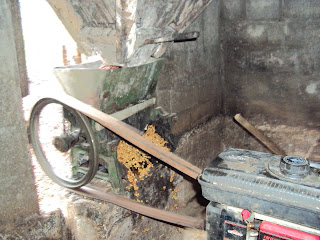
The farm owners, who hire the pickers, “de-pulp” the berries using a type of motorized press, squeezing off the fruity red outer-layer. The beans , inside the red berry part, have a yellow/tan “husk” covered in a sticky liquid called “miel’ (honey). Most farmers, after they de-pulp, wash the beans to clean off the miel. Then they have to decide who to sell their beans to. In my town, the options are one rich family that owns their own company, one “middle-man” who has the reputation for ripping people off price-wise, and then there is the cooperative I work with.

My coop weighs the coffee that comes in and pays the farmer according to the price that day on the commodities market in New York. But, since the official commodity is dried coffee, and the farmers are selling wet coffee, the coop has to take off a discount for the humidity level of the beans. Usually we subtract 45-55% for humidity, depending on how much the farmers have dried their coffee before they bring it in. [The humidity-measuring device is actually pretty cool]

Once we’ve bought the coffee from the farmers, it’s got to pass through two stages of drying so that it reaches 10-12% humidity. More, and the beans would be at risk of going sour and/or rotting and less, and the beans would shrivel up and lose their flavor. Step one is solar: we spread out the beans on our outdoor patio and hope for a lot of sunlight. When it’s really sunny, it usually takes half a day to solar-dry the beans. Step two involves large spinning dryers that were donated to the coop by the USDA and imported from Brazil. Each one holds something like 30-40 bags (150lbs each) and takes approximately 30 hours. We have two dryers.

Grain elevators then shoot the dried coffee into the next room of our plant where the coffee is de-husked, i.e. where the bean loses that second, yellow protective layer. The de-husked coffee bean has a sort of dark green tint and looks more like a lentil than the typical roasted coffee one commonly thinks of.

Finally, the de-husked coffee is sorted by weight, then runs down a conveyor belt in front of which two lines of workers (predominantly women) sit and pick out the bad pieces for hours and hours. The sorted and selected de-husked coffee is bagged and sealed and stored and then awaits a truck to take it to the port for its long journey to Canada, where all of our coffee is exported.

The company that buys our coffee is Van Houtte, one of the bigger coffee name brands in Canada, and they roast, grind, and market it there and in the New England states—if you’re up for aimless browsing of the web, check out their special Single-Origin line and look for the San Luis Planes, Honduras brand. That’s us. Last year we exported 5500 “quintales,” which are 100 pound bags. That’s a lot of pounds of coffee to be moved, especially when you realize that the five factory workers move it all manually throughout every stage of the process. This year we expect to sell 1000 “quintales” more than last.

2. Vacation highlights: My mother and aunt and a friend of theirs came down to visit me for a week at the beginning of the month. And I’m pretty sure that our trip turned out to be most memorable for them.

Travelling in a 3rd world country isn’t necessarily an easy or smooth feat, to say the least. We had decided that renting a car would be the most comfortable… our goal was to avoid using the infamous bus system of Honduras, which is made up generally of 20-30 year old hand-me-down school buses from the US, which are mostly overcrowded with people and bags and sometimes animals, that run normally on inconvenient schedules. Sure there are a handful of “luxury” bus lines, but we opted for a little more freedom and comfort.

So, thank you Budget Rentals. We rented a shiny Toyota with “4 wheel drive” and headed for my site, where, sadly, it had been raining solidly for the past week. My town isn’t what you’d call “easy to get to” and the roads aren’t “in good condition” and the rain doesn’t “help things” and the tires on this shiny new rental car weren’t “appropriate.” Needless to say, we spun out on hill after hill until we just couldn’t go up any more. It was quite a dramatic attempt and, after everybody’s blood pressure began to increase relative to the incline of the road (ie steeply), we decided to scratch my town from the itinerary and turned around and left for Copan, the Mayan ruins.

The Mayan ruins were very interesting and possibly my favorite part of the trip. We hired a guide who was of Mayan descent and learned a lot about their history and culture. Copan was a city of about 20,000 that was in its peak as a cultural center from about 400-800AD. We got to see several stepped-pyramid temples and altars. There were also countless statues of kings and gods, a huge staircase of hieroglyphics, and a ball court. I asked our Mayan guide what he thought would happen in 2012 and he told us the whole end-of-the-world thing was all just a big misunderstanding. I’m relieved.

We spent the remainder of our trip on Roatan, one of the Bay Islands of Honduras. The boat ride out was quite choppy and one of the four of us, to remain unnamed, announced “uh oh” just before she got most vocally seasick into a handy pukebag. Our days on the island were spent swimming, eating and drinking beach drinks. It was rough. One morning, Aunt Julie and I went fishing just beyond the coral reef. Again, we’ll leave it nameless, but one of the two of us caught two and the other caught less than that.

Lesson learned: all in all is that interesting and memorable vacations can be had in Honduras, so anybody reading this, feel free to come down and visit, assuming I know you.

3. Happy holidays:

I’ll be spending Christmas and New Year’s in my site, with my host family and probably with various other families too. It’s nice to be back after having been travelling and I look forward to seeing how the holidays will be celebrated here. My guess is that celebrations will most likely involve bomb-sized, earth-shaking, glass-shattering firecrackers (see my October post for more ranting on firecrackers).

I send my best to friends and family back home.